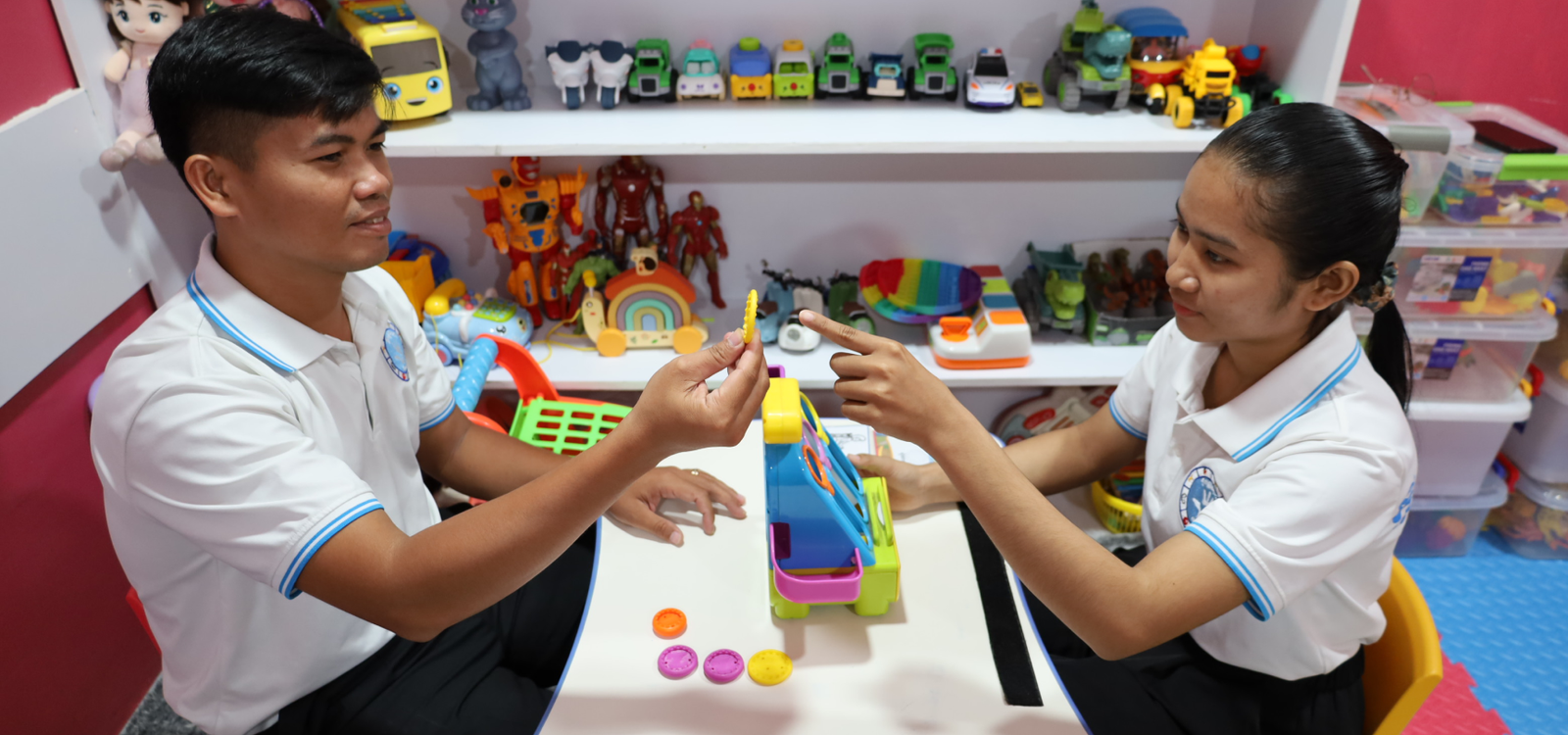
Speech & Language Therapy
Hope Kids provides affordable, inclusive, and professional education for children with autism and special needs in Phnom Penh and across Cambodia.
Speech & Language Therapy

Supporting Speech, Language, Communication, and Social Participation
What Is Speech & Language Therapy?
Speech
- Speech therapy may address:
- • Speech sound development
- • Articulation
- • Speech clarity
- • Phonological difficulties
- • Fluency
- • Voice
- • Motor speech difficulties
Language
- Language includes:
- • Understanding words and sentences
- • Vocabulary
- • Grammar
- • Asking and answering questions
- • Following instructions
- • Expressing ideas
- • Telling stories
- • Understanding concepts
Communication
- A child communicates through:
- • Spoken words
- • Gestures
- • Facial expressions
- • Body language
- • Eye gaze
- • Pictures
- • Signs
- • Writing
- • AAC systems
Who Can Benefit From Speech & Language Therapy?
Speech and language therapy may benefit children who experience difficulties with speech development, language development, understanding spoken language, expressing themselves, social communication, conversation, following instructions, speech clarity, communication through AAC, or feeding and swallowing. Children who may benefit include those with speech or language delay, Autism Spectrum Condition, ADHD, global developmental delay, developmental disabilities, intellectual disabilities, cerebral palsy, Down syndrome, communication disorders, motor speech difficulties, and other developmental or learning needs. A child does not necessarily need a formal diagnosis to benefit from a speech and language assessment.

Speech or Language Delay
Children with delayed speech or language development.

Autism Spectrum Condition
Children with ASC and communication needs.

ADHD
Children with attention and communication challenges.

Cerebral Palsy
Children with CP and speech or language needs.

Down Syndrome
Children with Down syndrome and communication needs.

Motor Speech Difficulties
Children with difficulty producing speech sounds.

Social Communication
Children needing support with conversation and interaction.

Other Developmental Needs
Children with other developmental or learning needs.
Speech vs. Language vs. Communication
What Skills Can Speech & Language Therapy Support?
Speech and language therapy can support receptive language, expressive language, speech sounds and clarity, and social communication.
Receptive Language
Receptive language is the ability to understand language. Children may work on understanding words, following instructions, understanding questions, learning concepts, understanding sentences, following conversations, and understanding stories.
Expressive Language
Expressive language is the ability to communicate thoughts, ideas, needs, and experiences. Therapy may support vocabulary, combining words, sentence development, grammar, answering questions, describing objects and events, telling stories, expressing opinions, and communicating feelings.
Speech Sounds & Clarity
Some children know exactly what they want to say but are difficult for others to understand. Speech therapy may address individual speech sounds, sound patterns, articulation, phonological development, and overall intelligibility.
Social Communication
Social communication involves using communication appropriately with other people. Children may work on initiating interaction, responding to others, taking conversational turns, asking questions, maintaining interactions, understanding conversational rules, sharing information, and understanding another person's communication.
Communication Does Not Have to Mean Speech
What Is AAC?
Augmentative and Alternative Communication (AAC) refers to methods used to supplement or replace spoken communication. AAC can range from simple systems such as pointing, gestures, picture boards, and communication books to high-tech systems such as tablets, speech-generating devices, and specialized communication software.
Speech Therapy for Children With Autism
How Does Speech Therapy Support Learning?
How Does Hope Kids Provide Speech & Language Therapy?
At Hope Kids Special Education School in Phnom Penh, speech and language therapy is individualized according to each child's communication profile, developmental level, strengths, needs, and goals. Our approach may include individualized assessment, individualized goals, play-based and functional intervention, AAC support, family collaboration, and progress monitoring.
Individualized Assessment
The therapist considers areas such as speech, receptive language, expressive language, social communication, play and interaction, functional communication, and AAC needs where appropriate.
Individualized Goals
Goals are based on skills that are meaningful for the child and family. For example: "The child will independently request preferred items using words, gestures, pictures, or AAC during everyday activities."
Play-Based & Functional Intervention
Young children often learn communication skills through play and meaningful interaction. Therapy may incorporate games, toys, books, routines, and activities that are motivating for the child.
AAC Support
When appropriate, children may be supported to develop communication using pictures, gestures, signs, communication systems, or speech-generating devices.
Family Collaboration
Parents and caregivers can learn strategies for creating communication opportunities during everyday routines.
Progress Monitoring
Goals and intervention strategies are reviewed as the child's communication develops.
How Parents Can Support Communication at Home
Why Speech & Language Therapy at Hope Kids?
At Hope Kids Special Education School in Phnom Penh, we look beyond speech alone. A child may need support with speech sounds, but another may need help understanding language, expressing ideas, communicating needs, participating socially, or using AAC. Our approach therefore considers the child's whole communication profile. Where appropriate, Speech & Language Therapy can be coordinated with Special Education, ABA & Behavioral Support, Structured Teaching (TEACCH), Occupational Therapy, Sensory Integration Therapy, Physiotherapy, Early Intervention, and Parent Training. The goal is to help children develop communication that is functional, meaningful, and useful in everyday life.
Whole Communication Profile
We consider the child's complete communication profile, not just speech.
AAC Support
Support for children who use or may benefit from AAC systems.
Functional Communication
Focus on meaningful communication in everyday life.
Multidisciplinary Approach
Speech therapy coordinated with OT, ABA, TEACCH, physiotherapy, and early intervention.
Evidence-Based Practice
Intervention informed by current research, clinical expertise, and family input.
Family-Centred
Parents are partners in understanding goals and supporting communication at home.
Frequently Asked Questions
Speech & Language Therapy in Phnom Penh, Cambodia
If your child is experiencing difficulties with speech, language, communication, social communication, or understanding and expressing language, a professional speech and language assessment can help identify their strengths and support needs. Hope Kids Special Education School provides individualized Speech & Language Therapy in Phnom Penh, Cambodia, supporting children with developmental delays, Autism Spectrum Condition, communication difficulties, and other developmental needs. Our services may include support for speech development, language, functional communication, social communication, and AAC, depending on each child's individual profile.
Contact UsContact Hope Kids
If your child is experiencing difficulties with speech, language, communication, social communication, or understanding and expressing language, a professional speech and language assessment can help identify their strengths and support needs.